FAQ
1General Questions
- 1-1-1What is a “Social Reintegration Center”?
The four correctional facilities developed by the Ministry of Justice through the Private Finance Initiative (PFI) and opened between April 2007 and October 2008 are referred to as “Social Reintegration Centers.”
In addition to the Shimane Asahi Social Reintegration Center, these include the Mine Social Reintegration Center (Yamaguchi Prefecture), the Kitsuregawa Social Reintegration Center (Tochigi Prefecture), and the Harima Social Reintegration Center (Hyogo Prefecture).- 1-1-2What are the features of the Shimane Asahi Social Reintegration Center?
The Shimane Asahi Social Reintegration Center (hereinafter referred to as “the Center”) is characterized first by its public–private partnership-based operational model, which combines the knowledge and experience of the national government with the expertise of the private sector. In addition, as the facility was established in Asahi Town at the invitation of the local community, the Center places great importance on working together with community stakeholders.
The Center’s mission is for the public and private sectors to work together with the local community to prevent reoffending by inmates—in other words, to help rehabilitate individuals and support their reintegration into society.
Notable initiatives include a pen pal program supported by local volunteers, a therapeutic community program, a guide dog puppy-raising program, and agricultural work in the Shinkai housing complex.- 1-1-3What kind of inmates are housed at the Center?
Male inmates who meet conditions such as (1) being incarcerated in prison for the first time, (2) not having ties to organized crime groups, (3) not having significant physical or mental disabilities, and (4) being able to adapt to communal living are housed at the Center. At the Center, inmates are referred to as “trainees.”
- 1-1-4What kind of meals are provided to trainees?
- As with other correctional institutions, the caloric content of staple foods served at the Center is determined based on factors such as gender, height, and the intensity of assigned work, while the caloric and nutritional content of side dishes is determined according to gender.
At the Center, a private contractor prepares seasonally inspired menus, with meals cooked primarily using locally sourced ingredients. In order for trainees to experience the “warmth of local producers” through food, the Center holds “Shimane Day” three times a year.
The photo shows an example of a “Shimane Day” meal. It features an abundance of regional ingredients, including “pork stamina stir-fry” made with Kenboro pork produced in Shimane Prefecture and “Rikyu manju,” a traditional confectionery from Hamada City.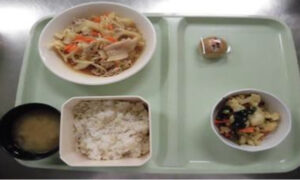
- 1-2-1Is [name] currently housed at the Center?
Even if you are a relative, we cannot respond to any inquiries regarding whether a specific individual is currently or was previously housed at the Center, nor to any questions that presume a specific individual is or was housed at the Center.
- 1-2-2What is the address of the Center?
The address is 380-15 Marubara, Asahi-cho, Hamada City, Shimane Prefecture. The postal code is 697-0492.
- 1-2-3Is parking available at the Center?
There is a free car park at the Center.
- 1-2-4How can I get there by public transportation?
The Center is about a 15-minute walk (approximately 3 minutes by taxi, although taxis are not always waiting) from the “Asahi Interchange” bus stop on the highway bus route operating between Hiroshima Station Shinkansen Exit and Hamada Station. The highway bus ride from Hiroshima Station Shinkansen Exit to the Asahi Interchange stop takes approximately two hours.
- 1-2-5Are there any accommodations nearby?
Several accommodation facilities are available at Asahi Onsen, located about a 5-minute drive from the Center. For further details, please contact accommodation facilities directly.
- 1-2-6What are the contact details for the Center?
If you have any inquiries regarding the Center, please call 0855-45-8171 between 8:30 a.m. and 5:00 p.m. on weekdays. Please note that inquiries by email or other electronic means are not accepted.
- 1-3-1Is it possible to tour the Center?
Tours are permitted when they are necessary for academic research or are otherwise recognized as beneficial for promoting public understanding of correctional institutions, provided that they are not likely to interfere with the maintenance of discipline and order at the Center or with its management and operation. In principle, tours are conducted on Tuesdays and Thursdays (from 10:00 a.m.) and on Wednesdays and Fridays (from 1:00 p.m.), excluding national holidays. If you wish to arrange a tour, please contact the Center by telephone.
- 1-3-2How many people can participate in a tour?
The maximum number of participants for a tour is 40 people. If you wish to organize a tour for more than 40 people, please contact the Center to discuss arrangements.
- 1-3-3When can tour reservations be made?
Tour reservations are accepted starting one month before the desired tour date. Please make your reservation no later than three days prior to the tour date (excluding Saturdays, Sundays, and national holidays).
- 1-4-1I would like to conduct a media interview or cover the Center.
For inquiries regarding media coverage by newspapers, magazines, television, etc., please contact the Investigation Officer of the General Affairs Department.
- 1-4-2I am a former inmate. I would like a certificate of incarceration issued.
There are two ways to apply.
- Application at the Service Counter
Please come to the Center between 8:30 a.m. and 5:00 p.m. on weekdays, bringing a form of identification and your personal seal (inkan). - Application by Mail
Please send the following three items (1)–(3) by mail. The certificate will be sent at a later date using the enclosed return envelope.- (1) A written request stating the following information:
・Registered domicile (honseki)
・Name
・Date of birth
・Date of release
・The reason the certificate of incarceration is required
・The main purposes for issuing a certificate of incarceration include applications
for:
(1) Renewal of a driver’s license
(2) Residence card or Special permanent resident certificate procedures
(3) Child-rearing allowance benefits
(4) Public assistance and related support
(5) Reduction or exemption of National Health Insurance premiums
If the certificate is required for reasons other than those listed above, please clearly and specifically state the reason and attach copies of any documents that can substantiate it as much as possible. - (2) A return envelopePlease write your return address and name on the envelope and affix the appropriate postage stamp. Do not write anything on the back of the envelope.
- (3) A copy of your ID (such as a driver’s license or passport)
In principle, please submit a copy of an identification document with a photograph.
- (1) A written request stating the following information:
- Application at the Service Counter
2Frequently Asked Questions from Family Members, etc. of Trainees
- 2-1-1 I am a relative of a trainee. Is visitation permitted?
In principle, visitation is permitted. Procedures will proceed more smoothly if the trainee has registered you in advance as a person they wish to receive visits from. Please confirm the registration details with the trainee by letter. Please note that the Center cannot respond to individual inquiries regarding a trainee’s visitor registration details. When attending a visit, identity verification is required, so please bring a photo ID (such as a driver’s license or passport).
- 2-1-2I am an acquaintance of a trainee. Is visitation permitted?
Persons who may pose a risk of disrupting the discipline and order of the Center, those considered likely to interfere with the proper implementation of the trainee’s correctional treatment, or those whose identity cannot be verified, are not permitted to visit trainees.
Procedures will proceed more smoothly if the trainee has registered you in advance as a person they wish to receive visits from. Please confirm the registration details with the trainee by letter. However, please note that letters may not always be delivered to the trainee. In addition, the Center cannot respond to individual inquiries regarding a trainee’s visitor registration details.
Even if visitation has been permitted at another facility, visitation may still be denied at the Center’s discretion. When attending a visit, identity verification is required, so please bring a photo ID (such as a driver’s license or passport).
- 2-1-3It would be disappointing if I am told on the day that visitation is not possible.
We fully understand that this may be particularly difficult for those who have come from far away. However, please understand that under applicable laws and regulations, whether visitation is permitted must be decided on a case-by-case basis after a request for visitation is made. At the Center, visitation is generally not permitted in the following cases:
- (1) If the trainee refuses the visit. (For example, the trainee may already have arranged to meet another visitor, and accepting an unexpected visitor could cause them to reach the monthly visitation limit, preventing the previously arranged visit from taking place. Such situations occur from time to time.)
- (2) If the trainee has already reached the monthly limit for visitation.
- (3) If the trainee is subject to disciplinary action (cell confinement) on that day.
- (4) If the visitor is not a relative or similar person and there are no circumstances indicating that the visit is necessary for the trainee.
- (5) If the visit is considered likely to disrupt the discipline and order of the facility or interfere with the proper implementation of the trainee’s correctional treatment.
- (6) If the identity of the visitor cannot be verified.
- 2-1-4On which days is visitation accepted?
In principle, visitation is accepted on weekdays from Tuesday to Friday, as well as on Saturdays. On Saturdays, priority is given to “reserved visitations” for individuals who have previously visited. The available visitation dates for each month are posted on the Center’s website as they are updated
- 2-1-5What are the reception hours for visitation?
Reception hours for visitation are 8:30 a.m. to 11:30 a.m. and 1:00 p.m. to 4:00 p.m. on visitation days.
- 2-1-6Is there a limit on the number of people who can enter the visitation room?
Up to three people may attend a single visit. However, additional persons may be permitted in certain cases, such as when a visitor is accompanied by an infant or small child.
- 2-1-7Is there a limit on the number of visitations?
The same visitor may meet with the same trainee only once per day. In addition, there are limits on the number of visits a trainee may receive. The limit varies depending on the trainee’s privilege classification, but in the lowest category the limit is up to two visits per month. Therefore, we recommend making arrangements with the trainee in advance by letter before visiting.
Please note that the Center cannot respond to individual inquiries regarding a trainee’s visitation limits or related details.
- 2-1-8How long does a visitation last?
The duration of a visit is generally 30 minutes. However, depending on the visitation situation on the day (for example, if there are many visitors or if some visitation rooms are unavailable), the visit may be shortened to between five and 30 minutes.
- 2-1-9How can I make a reservation for visitation?
For individuals who have previously visited a trainee at the Center, an ID and password are issued, allowing them to reserve a visitation room in advance through the Center’s website. This system is referred to as a visitation reservation. Please note that a visitation reservation only reserves a visitation room and does not guarantee that the visit will take place.
Because the ID and password may be used only by the individual to whom they are issued, those wishing to make visitation reservations must first come to the Center and conduct a visit at least once.
- 2-1-10Is visitation not possible without a reservation?
A visitation reservation is intended to reduce waiting times for visitors. It is not a requirement for visitation, and visits may still be conducted without making a reservation.
- 2-1-11I cannot make a reservation using the visitation reservation system.
Under the visitation reservation system, reservations must be made at least three days prior to the visitation date. Sundays, Mondays, and national holidays are not included in this calculation. Please make your reservation well in advance. If the reservation slot is marked with an “X,” it means that the reservation capacity has been reached. Please select another preferred visitation date.
If you lose your ID or password, please contact the Center by telephone on a weekday between 8:30 a.m. and 5:00 p.m.
- 2-1-12Can visitation reservations be made by telephone?
Visitation reservations can also be made by telephone. Please call the Center on weekdays between 8:30 a.m. and 5:00 p.m. When making a reservation, you will need the ID and password that were provided to you at your previous visit.
- 2-1-13Is it possible to call a trainee by telephone?
It is not possible to call a trainee by telephone. In addition, Center staff cannot accept or relay messages. If you wish to contact a trainee, please do so through visitation or by letter.
However, in certain cases and when specific conditions are met, trainees may be permitted to make outgoing telephone calls.
- 2-2-1Is it possible to exchange letters with a trainee?
Persons with criminal intent, or those whose correspondence may disrupt the discipline or order of the Center or interfere with the proper implementation of correctional treatment for inmates (excluding relatives), may in some cases not be permitted to send or receive correspondence. In addition, depending on the content of the letter—for example, if it contains codes or ciphers, material that violates criminal laws, content that may disrupt the discipline and order of the Center, or content that may interfere with the proper implementation of correctional treatment—the correspondence may be restricted (such as by withholding, deletion, or redaction).
- 2-2-2A relative has passed away. Could you inform the trainee?
The Center cannot relay messages to trainees. If the matter is urgent, we recommend informing the trainee by letter (such as express mail), telegram, or similar means.
- 2-2-3I have not received a reply to my letter.
The Center cannot respond to inquiries regarding records of letters sent by trainees.
- 2-2-4How many letters may be exchanged per month?
There are restrictions on letters sent by trainees. The limit varies depending on the privilege classification, but in the lowest category, trainees are limited to sending up to four letters per month.
There is no limit on the number of letters that trainees may receive.
- 2-2-5Are letters delivered to trainees even on holidays?
In principle, regular incoming mail received on days when the Center is closed is delivered to trainees on the next weekday following inspection and processing. However, urgent items such as express mail or telegrams are processed even on days when the Center is closed, and may therefore be delivered on the same day.
- 2-2-6A letter I sent to a trainee was returned to me.
The Center cannot respond to inquiries regarding the sending or receipt of letters by a specific trainee.
- 2-2-7Who is not permitted to send or receive correspondence with a trainee?
Persons with criminal intent, or those whose correspondence may disrupt the discipline and order of the Center or interfere with the proper implementation of correctional treatment for inmates (excluding relatives), may not be permitted to send or receive letters. However, this restriction does not apply when correspondence is necessary for handling matters involving significant personal, legal, or business interests of the inmate, such as marital matters, the conduct of litigation, or business affairs.
- 2-2-8Is it acceptable to send cash together with a letter?
If you wish to send cash by mail, please do not enclose it in regular mail. Cash must be sent by registered cash mail (Genkin Kakitome).
- 2-3-1What items may be sent or brought in to trainees, and how many?
The types of items that one sender may send by mail to a trainee per day, as well as the maximum quantity that may be sent or brought in at one time, are shown in the table below. When a visitor comes to the Center, in addition to the items listed below, items purchased at the Center shop may also be brought in. For further details, please inquire at the Center reception desk or at the shop.
Item Amount Remarks Books 5 Supplementary items such as CDs and DVDs, posters that are not bound into the main publication and exceed A3 size, calendars, and trading cards cannot be sent or brought in as items for delivery. Please remove these before sending or bringing in the materials. Pamphlets 5 A total of up to five items, including pamphlets, catalogs, flyers, newsletters, and free papers Towels 2 Plain items only. Items with text, pictures, brand logos, stripes, woven patterns, or other designs are not permitted. Nylon materials are not allowed. The size must be within 90 cm × 45 cm. Handkerchiefs 2 Plain items only (same conditions as for towels below). The size must be standard size. Toothbrushes 1 Electric types are not permitted. Items that are considered unusual or non-standard compared to typical commercially available products are not allowed. Toothbrush Cases 1 Items made of standard plastic or vinyl. Soap Cases 1 Items with logos, pictures, or decorative elements are not permitted. Ear Picks 1 Metal types are not permitted. Only those with white cotton tips are allowed. Desk Mats 1 Plain items only, A4 size or smaller. Rulers 1 A straight ruler made of plastic, 30 cm or less in length. Photos Photos from L size (82 mm × 120 mm) up to A3 in size are allowed. Photo booth pictures or laminated photos are not permitted. Glasses, etc. Glasses without a vision-correcting function, including those with specially processed lenses such as tinted, polarized, or mirror-coated lenses, or those that are overly flashy (for example, with prominent luxury brand logos), are not permitted. Both hard and soft contact lenses with a vision-correcting function may be sent or brought in; however, colored contact lenses are not permitted. Only contact lenses that do not require special equipment, such as boiling for disinfection, are allowed. Contact lens cases may be sent or brought in, but contact lens cleaning solution is not permitted. Stamps and Postal Stationery Up to 10 government-issued postcards or postal letters may be sent or brought in at one time. The total value of stamps and related items that a trainee may keep in their room is limited to 5,000 yen. - * If items sent by mail differ significantly in material or shape from those sold at the Center’s shop, or if they have been modified, trainees may not be permitted to use them.
- * If items exceeding the quantities listed above are sent by mail, they may be returned to the sender with shipping charges to be paid upon delivery. Please ensure that the limits are carefully observed.
- * In accordance with applicable laws and regulations, some items may not be permitted. In such cases, the items will be returned, and the sender will be responsible for the return shipping costs.
- 2-3-2Are there restrictions on the color, pattern, or size of towels and handkerchiefs?
There are no restrictions on the color of towels and handkerchiefs; however, there are restrictions on patterns and size. Only plain items with no pictures, patterns (including woven patterns), text, or even small logos are permitted. The size must not exceed 90 cm × 45 cm.
- 2-3-3If underwear is sent or brought in, can it be used inside the Center?
Underwear may be used if it is purchased at the Center’s shop and then sent or brought in as a delivery item. Trainees may also purchase underwear designated by the Center.
- 2-3-4Are there limits on the number or size of photographs that may be sent or brought in?
There are no restrictions on the number or size of photographs that may be sent or brought in. However, photographs must be between L size (82 mm × 120 mm) and A3 in size.
Albums (including simple albums) may not be kept in trainees’ rooms, so please send or bring in photographs only. Please note that if photographs contain writing or other markings, it may take additional time before they can be handed over, and in some cases, trainees’ may not be permitted to keep them in their room.
- 2-3-5Can food be sent or brought in to trainees?
Food items are not permitted as delivery items.
- 2-3-6Is it possible to send items through online shopping or mail-order services?
If the name of the sender (the person placing the order) is not indicated, the item may not be accepted. Please ensure that the sender’s name and address are clearly stated when sending the item.
- 2-3-7How many books may be sent or brought in?
Up to five books per person per day. Please remove any supplementary items such as CDs, DVDs, unbound posters, calendars, or trading cards, as these cannot be sent or brought in.
- 2-3-8Are there any books that may not be sent or brought in?
In accordance with applicable laws and regulations, access to certain books may be prohibited if they are considered likely to disrupt the Center’s discipline and order or interfere with the appropriate implementation of correctional treatment for trainees.
- 2-3-9Is it acceptable to enclose cash with items being sent?
Cash sent by mail must be sent via Genkin Kakitome (registered cash mail).
- 2-3-10When can clothing and other items needed upon release be sent or brought in?
There are no specific regulations; however, it is generally recommended to send or bring them in after the committee interview has been completed or about one month before the scheduled release date. Items that arrive by the day before the release date can be handed to the individual at the time of release. However, please ensure that items arrive at least two days prior to the release date whenever possible. Items cannot be delivered on the day of release.
- 2-3-11How long does it take for items sent or brought in to reach the trainee?
In most cases, items are delivered to the individual within about four to five days from the date they are received. However, it may take longer depending on holidays, periods with a large number of deliveries, or the type of items.
- 2-3-12I received a letter stating that the items I sent have not arrived.
We can provide information about the general handling of delivery items; however, we are unable to respond to inquiries regarding the status of individual deliveries.
- 2-3-13Can items be sent or brought in on Saturdays?
Cash cannot be delivered on Saturdays. Items other than cash are generally accepted in the same manner as on weekdays.
- 2-3-14Can items identical to those sold at the Center shop be purchased elsewhere and sent or brought in?
As indicated in the list above, items that are permitted to be sent or brought in from outside may be delivered. However, items such as underwear cannot be accepted from outside, even if they are identical to those sold at the shop.
- 2-4-1Why did I receive this document?
- A. Regarding the “Inquiry Form”
This form is used to confirm your relationship with the trainee and the fact that you sent or brought in the delivery item. Please complete the enclosed “Response Form” and return it to the Center.
Examples:
1) No letters have previously been exchanged, and the Center needs to confirm the relationship with the trainee.
2) No notice of a change of address has been received, and the current situation needs to be confirmed.
3) The item was sent from a location different from the registered address, and the circumstances need to be confirmed. - B. Regarding the “Notice Concerning Collection of Delivered Money or Items”
This notice is sent when money or items delivered cannot be accepted under applicable laws and regulations. It asks how you would like the items to be returned. Please complete the enclosed “Response Form for the Collection of Delivered Money or Items” with the return method and send it back to the Center. - C. Regarding the “Notice Concerning the Collection of Delivered Books, etc.”
This notice is sent when books or other items have been delivered in excess of the permitted quantity. When returning the items, please indicate the preferred return method on the enclosed “Response Form” and return it to the Center. - D. Regarding “Items That Cannot Be Used or Possessed Within the Facility”
This notice is sent when books or other delivered items include supplementary materials that are not permitted to be used or possessed within the Center.
- A. Regarding the “Inquiry Form”
- 2-4-2I do not remember the title of the book I sent.
Providing part of the title or the author’s name, if you remember it, is sufficient. It is also acceptable to respond in general terms, such as “I sent several paperback books” or “I sent a sports magazine.”
- 2-4-3I did not send or bring in any items.
If you receive the above-mentioned “Inquiry Form,” “Notice Concerning Collection of Delivered Money or Items,” or “Notice Concerning the Collection of Delivered Books, etc.” despite not having sent or brought in any delivery items, please indicate this on the enclosed “Response Form” and return it to the Center.
In addition, if you receive the documents “Request Regarding the Limit on the Number of Books, etc. Sent as Delivery Items” or “Items That Cannot Be Used or Possessed Within the Facility” and they do not apply to you, please contact the office listed in the document.
- 2-4-4Why can the item not be accepted as a delivery item?
It has been determined that the item cannot be accepted as a delivery item in accordance with applicable laws and regulations.
- 2-5-1Will I be notified if parole is granted?
If you are the designated guarantor, you will be notified by mail when the parole date approaches. We are unable to provide this information to anyone other than the designated guarantor.
- 2-5-2I am unable to go to pick the inmate up upon release. Is it necessary for me to do so?
Arrangements are made so that trainees can return to their place of residence even if no one comes to meet them. Please come only if it is convenient for you.
- 2-5-3I would like to send or bring in clothing for use upon release.
If sending or bringing in clothing, please ensure that it arrives at least two days prior to the release date whenever possible. Trainees who do not have clothing suitable for the season at the time of release will be provided with clothing as necessary.
- 2-6-1Is [name] currently housed at the Center?
We are unable to respond to any inquiries regarding whether a specific individual is (or was) being held at the Center.
- 2-6-2I would like a certificate of incarceration issued.
A certificate of incarceration is issued at the request of the trainee. Please ask the trainee directly by letter, clearly stating the reason the certificate is required and attaching copies of any documents that can verify the need, if available.
Please note that, in principle, certificates of incarceration are issued only for submission to public authorities for official procedures, such as applications for reductions in National Health Insurance premiums or applications for public assistance. They cannot be issued for private purposes or for reasons of personal convenience.
- 2-6-3The trainee’s driver’s license is about to expire.
Persons who entered a correctional facility on or after June 20, 2001, and whose driver’s license expired while in custody may, upon request, take the driver’s license examination at the Center once per year, provided that less than three years have passed since the expiration date and that they remain continuously detained under a sentence of imprisonment with or without labor.
When a driver’s license examination is scheduled to be held at the Center, trainees will be notified in advance. If a trainee’s driver’s license is about to expire, please inform the trainee by letter.
3Frequently Asked Questions from Family Members, etc. of Defendants Held in the Detention Unit
- 3-1-1I am a relative/acquaintance of a detainee. Is visitation permitted?
Pretrial detainees (including those held in detention rooms; the same applies hereafter) may, in principle, receive visits except in the following cases:
- A. When visits or communication have been prohibited under the provisions of the Code of Criminal Procedure
- B. When the detainee is subject to disciplinary punishment (cell confinement)
Identification is required when visiting, so please bring a photo ID (such as a driver’s license or passport).
- 3-1-2On which days is visitation accepted?
In principle, visits are accepted on weekdays from Monday to Friday. The days on which visits are available each month are posted on the Center’s website as they are updated.
- 3-1-3What are the reception hours for visitation?
- 3-1-4Is there a limit on the number of people who can enter the visitation room?
- 3-1-5Is there a limit on the number of visits?
A pretrial detainee may receive up to two visits per day (excluding visits with defense counsel, etc.). However, visits with the same visitor are limited to once per day.
- 3-1-6How long does a visitation last?
- 3-1-7Is it possible to call a detainee by telephone?
It is not it possible to call a detainee by telephone. In addition, staff at this branch office cannot take or relay messages. Please contact the detainee through visits or by letter.
- 3-2-1Is it possible to exchange letters with a detainee?
In the case of pretrial detainees, correspondence is generally permitted except when communication has been prohibited by a court order. However, depending on the content of the letter—for example, if it contains codes or ciphers, material that violates criminal laws, content that may disrupt the discipline and order of the Center, or content that could result in the destruction or concealment of evidence—the correspondence may be restricted (such as by withholding, deletion, or redaction).
- 3-2-2A relative has passed away. Could you inform the detainee?
- 3-2-3I have not received a reply to my letter.
- 3-2-4How many letters may be exchanged per day?
Pretrial detainees may send up to two letters per day (excluding letters sent to their attorney or other legal representatives). There is no limit on the number of letters a detainee may receive.
- 3-2-5Are letters delivered to detainees even on holidays?
- 3-2-6A letter I sent to a detainee was returned to me.
- 3-2-7Who is not permitted to send or receive correspondence with a detainee?
In the case of pretrial detainees, the court may prohibit the exchange of documents—including letters—with certain individuals, except for attorneys and other legal representatives.
- 3-2-8Is it acceptable to enclose cash with a letter?
- 3-3-1What items may be sent or brought in, and how many?
- 3-3-2Are there restrictions on the color, pattern, or size of towels?
- 3-3-3If clothing is sent or brought in, can it be used inside the Center?
Pretrial detainees are permitted to use their own clothing (including socks, tights, and tabi) and bedding. However, such items may not be allowed if their use would interfere with the Center’s discipline and order or otherwise hinder its management and operation.
- 3-3-4Are there limits on the number or size of photographs that may be sent or brought in?
- 3-3-5Can food be sent or brought in?
Food items (such as sweets, cup noodles, and beverages) can be sent or brought in to pretrial detainees by placing an order through the Center’s shop. The maximum value of food that one sender may provide to a specific pretrial detainee is limited to 2,000 yen per day.
Please note that even if an item is sold in the Center’s shop, some products may not be handled as allowable care package items, and there may also be quantity limits. For details, please inquire directly at the shop.
- 3-3-6Is it possible to send items through online shopping or mail-order services?
- 3-3-7How many books may be sent or brought in?
There is no strict limit on the number of books one person may send or bring in at a time. However, sending or bringing in a large number of books at once may cause management difficulties, so we kindly ask for your cooperation in limiting books to around five at a time. Please note that supplementary items such as CDs, DVDs, loose posters, calendars, and trading cards cannot be sent or brought in. If these are included with a book, please remove them beforehand.
- 3-3-8Are there any books that may not be sent or brought in?
For pretrial detainees, access to certain books may be prohibited under applicable laws if their content could potentially disrupt the Center’s discipline or order, or if it could lead to the destruction or concealment of evidence.
- 3-3-9s it acceptable to enclose cash with items being sent?
- 3-3-10When can clothing and other items needed upon release be sent or brought in?
- 3-3-11How long does it take for items sent or brought in to reach the detainee?
- 3-3-12I received a letter stating that the items I sent have not arrived.
- 3-3-13Can items be sent or brought in on Saturdays?
Items cannot be sent or brought in on Saturdays, Sundays, national holidays, or during the New Year holiday period (December 29 to January 3).
- 3-3-14Can items identical to those sold at the Center shop be purchased elsewhere and sent or brought in?
In addition to the items listed in Q2-3-1, the items shown in the table below may be sent or brought in to pretrial detainees if they are of the same specifications (or equivalent) as those sold at the Center’s shop. For other items handled by the shop, items purchased at outside stores cannot be accepted as care packages, even if brought to the facility.
*Please inquire at the Center’s shop to confirm whether a particular item is sold there.
Item Remarks Writing Materials Colored paper (including tanzaku), carbon paper, Japanese manuscript paper (genko yoshi), and report paper. Clothing Shirts, underwear, long underwear, pajamas, and socks.
- 3-5-1Will I be notified when a detainee is released?
In the case of parole, the designated guarantor will be notified in advance in writing. For other types of release, no notification will be provided, except in cases required by law.
4Frequently Asked Questions from Employers Considering Hiring Former Inmates
- 4-1-1What kind of system is the “Free Employment Placement Service”?
The “Free Employment Placement Service” is a system, authorized by the Minister of Health, Labour and Welfare, that provides free mediation between job seekers (people looking for work) and employers (companies seeking workers).
At the Center, approval from the Minister of Health, Labour and Welfare was obtained on January 1, 2014, and the service offers employment placement specifically for trainees seeking work, connecting them with employers across a wide range of industries nationwide.Businesses interested in participating are welcome to contact the office below:
Asahi Free Employment Placement Office Social Reintegration Promotion Department, SSJ Co., Ltd.
Contact: Watanabe
Phone: 0855-45-8197
Address: 380-15 Marubara, Asahi-cho, Hamada City, Shimane 697-0492, Japa
- 4-2-1What kinds of vocational qualifications can trainees obtain?
The Center provides a variety of vocational training programs, and many trainees obtain the qualifications listed below through these programs. For information on the characteristics of the Center’s trainees, please see Q1-1-3.
Medical Administrative Assistant Word Processing Technician (Levels 1–3) Entry-Level Care Worker Training Spreadsheet Technician (Levels 1–3) Slinging Skills Training Certificate Database Technician (Levels 1–3) Small Mobile Crane Operation Skills Training Certificate CAD User Certification Exam (Level 2) Forklift Operation Skills Training Certificate Photoshop Creator Proficiency Certification Aerial Work Platform Operation Skills Training Certificate Communication Certification Barber License Retail Sales Associate (Level 3) In addition to these, although formal qualifications are not awarded, the Center provides vocational training in areas such as video editing, bread making, Braille translation, and audio transcription. As part of prison work programs, trainees also gain experience in welding, painting, woodworking, and other skills. Many trainees therefore possess these practical skills, and some also hold various qualifications they obtained prior to incarceration. We encourage employers to consider hiring individuals upon their release.